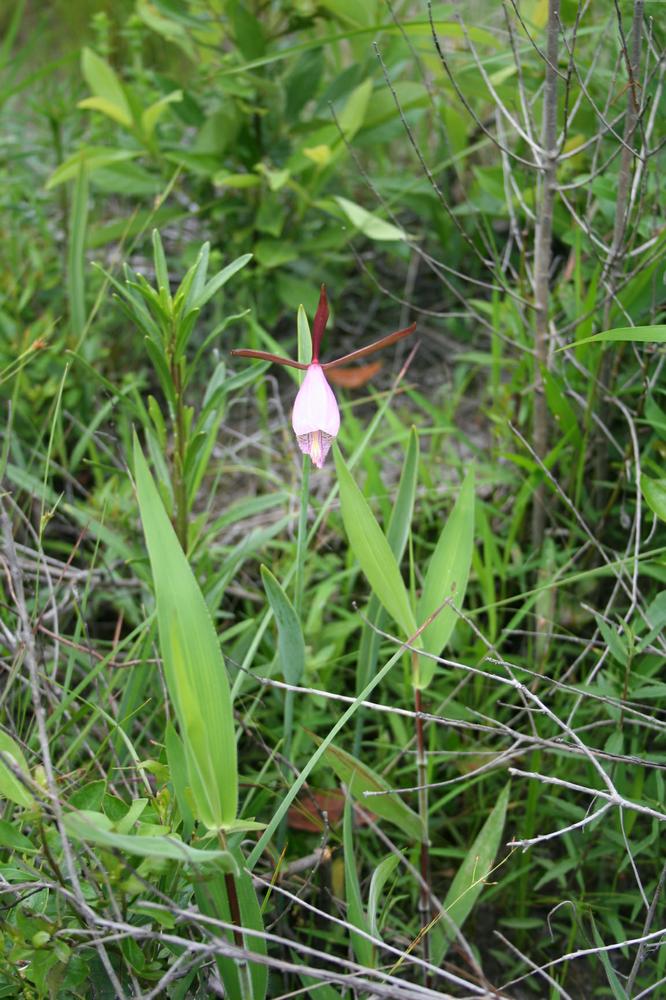
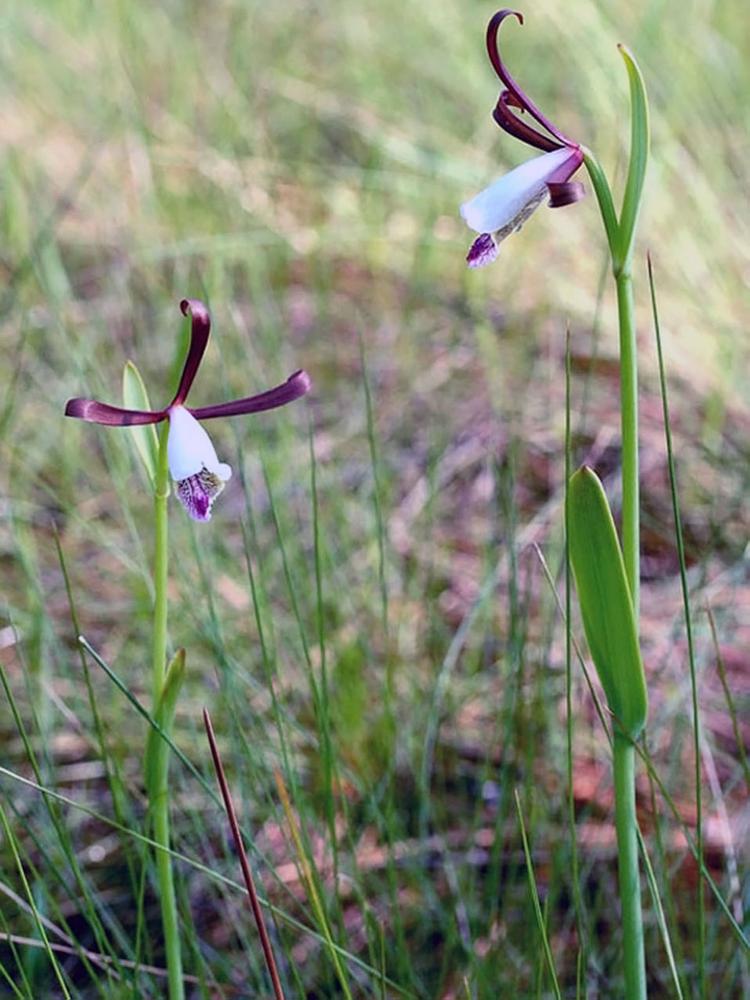
Cleistesiopsis oricamporum P.M.Br.
Coastal Plain Pogonia
Facts About
Accepted Synonyms: None
Cleistesiopsis oricamporum is a recently described orchid found on the coastal plain in the southeast. Similar in appearance to the mountain species, C. bifaria, these coastal plain plants represent genetically distinctive populations with morphological differences. C. oricamporum is somewhat larger in size than C. bifaria and its flowers have a sweet vanilla fragrance that is lacking in the mountain species. C. oricamporum prefers moist, acid soils such as wet meadows and cut-over pine forests. This orchid may occur with C. divaricata, a species with larger flowers that blooms later in the season.
Pollination
Bees in the genus Bombus are attracted to the bright yellow crest on the labellum which mimics pollen. As it enters the flower, a sticky fluid is smeared on the bee’s head and thorax. When it backs out of the flower, granular pollen sticks to this fluid and can be transferred to the stigma of the next flower the bee visits. While the bees may be lured to the flower by deceit, pollen may be actively harvested and transferred from flower to flower and also brought back to the hive.
Ecosystem Type
Forests, grassland, savanna, shrublands or thickets, woodlands
Characteristics
- Habitat:
- terrestrial
- Leaf arrangement:
-
- alternate
- stem
- Number of leaves on stem:
-
- one
- two
- Form of the labellum:
- the labellum is not pouch-like
- Labellum outline:
- the labellum is lobed
- Main color of labellum:
-
- pink to red
- white
- Nectar spur:
- absent
- Inflorescence type:
- the inflorescence has one flower or a pair of flowers
- Labellum characteristics:
- the labellum is lobed
-
Flowers
- Flower petal color:
-
- pink
- white
- Flower symmetry:
- the flower is zygomorphic
- Flowering date:
-
- April
- May
- Flowers per inflorescence:
- At least 1
- Form of the labellum:
- the labellum is not pouch-like
- Hairs on flower stalk:
- the pedicel is hairless
- Hairs on inflorescence axis:
- the inflorescence stem is hairless
- Inflorescence type:
- the inflorescence has one flower or a pair of flowers
- Labellum characteristics:
- the labellum is lobed
- Labellum outline:
- the labellum is lobed
- Labellum position:
- the flowers are resupinate
- Lower petal strongly red-veined:
- yes
- Main color of labellum:
-
- pink to red
- white
- Nectar spur:
- absent
- Number of stamens:
- 1
- Orientation of side petals:
- the lateral petals are spreading
- Pollen sacs:
- the pollinia eventually fragment into smaller parts
- Self-pollinating flowers:
- there are no cleistogamous flowers
- Sepals fused only to sepals:
- the sepals are separate from one another
- Spots on labellum:
- no
-
Fruits or seeds
- Seed capsule orientation:
- the capsule points upwards or outwards
-
Growth form
- Roots:
- the rhizomes are non-coralloid
- Underground organs:
-
- slender roots
- this plant has a rhizome
- myco-heterotrophic or not:
- the plant is chlorophyllous
-
Leaves
- Bract relative length:
- the bract is shorter than the associated flower
- Leaf arrangement:
-
- alternate
- stem
- Leaf blade edges:
- the leaf edges are entire
- Leaf blade shape:
- oblong
- Leaf blade tip:
- the tip of the leaf blade is obtuse
- Leaves during flowering:
- leaves are present during flowering
- Number of leaves on stem:
-
- one
- two
-
Place
- Ecosystem type:
-
- forests
- grasslands
- savanna
- shrublands or thickets
- woodlands
- Habitat:
- terrestrial
- Location:
-
- Alabama
- Florida
- Georgia
- Louisiana
- Mississippi
- North Carolina
- South Carolina
- Virginia
-
Facts and Uses
- Mycorrhiza
- Monitoring
- Propagation
- Restoration
Native to North America
Yes
North American Conservation Status & Distribution
Conservation Status
| Conservation and Wetland Status | |
|---|---|
| Global Rank | Vulnerable |
| US Status | N/A |
| Canadian Status | N/A |
| Conservation status for: Alabama | |
|---|---|
| Global Rank | Vulnerable |
| US Status | N/A |
| Alabama Rank | Apparently Secure |
| Alabama Status | N/A |
| Canadian Status | N/A |
| Wetland Status | N/A |
| Conservation status for: Florida | |
|---|---|
| Global Rank | Vulnerable |
| US Status | N/A |
| Florida Rank | Watch List |
| Florida Status | Species of Concern |
| Canadian Status | N/A |
| Wetland Status | N/A |
| Conservation status for: Georgia | |
|---|---|
| Global Rank | Vulnerable |
| US Status | N/A |
| Georgia Rank | N/A |
| Georgia Status | N/A |
| Canadian Status | N/A |
| Wetland Status | N/A |
| Conservation status for: Louisiana | |
|---|---|
| Global Rank | Vulnerable |
| US Status | N/A |
| Louisiana Rank | Highly State Rare |
| Louisiana Status | Endangered |
| Canadian Status | N/A |
| Wetland Status | N/A |
| Conservation status for: Mississippi | |
|---|---|
| Global Rank | Vulnerable |
| US Status | N/A |
| Mississippi Rank | Watch List |
| Mississippi Status | Species of Concern |
| Canadian Status | N/A |
| Wetland Status | N/A |
| Conservation status for: North Carolina | |
|---|---|
| Global Rank | Vulnerable |
| US Status | N/A |
| North Carolina Rank | State Rare |
| North Carolina Status | Threatened |
| Canadian Status | N/A |
| Wetland Status | N/A |
| Conservation status for: South Carolina | |
|---|---|
| Global Rank | Vulnerable |
| US Status | N/A |
| South Carolina Rank | Watch List |
| South Carolina Status | Species of Concern |
| Canadian Status | N/A |
| Wetland Status | N/A |
| Conservation status for: Virginia | |
|---|---|
| Global Rank | Vulnerable |
| US Status | N/A |
| Virginia Rank | Highly State Rare |
| Virginia Status | Endangered |
| Canadian Status | N/A |
| Wetland Status | N/A |