Cypripedium candidum Muhl. ex Willd.
White Lady's Slipper
Facts About
Accepted Synonyms: Calceolus candidus
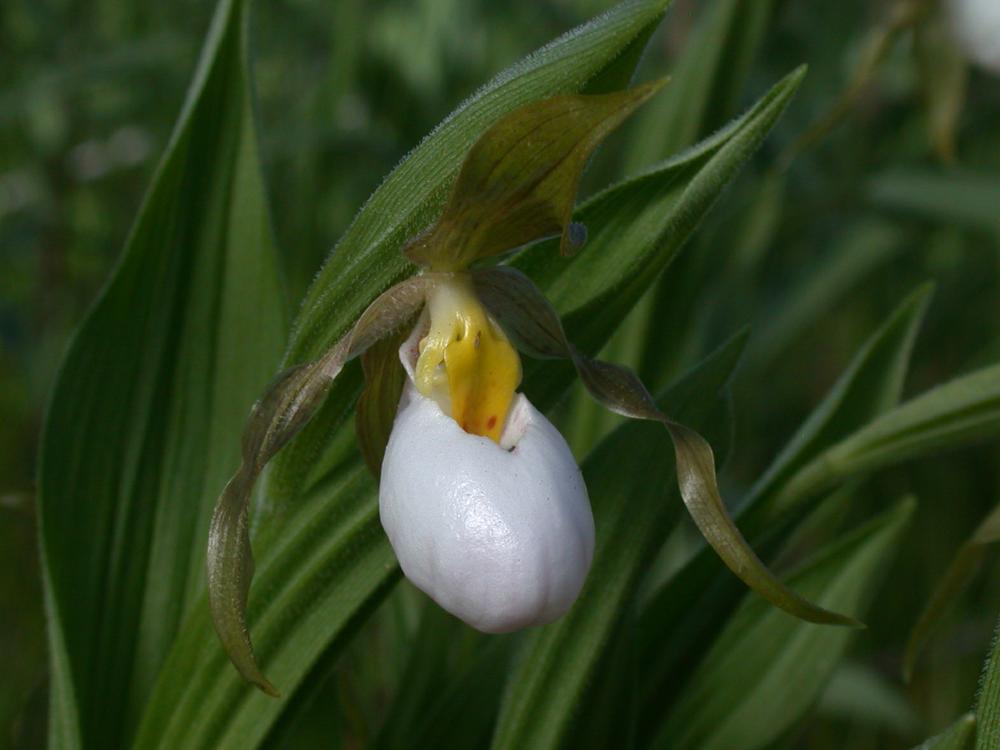
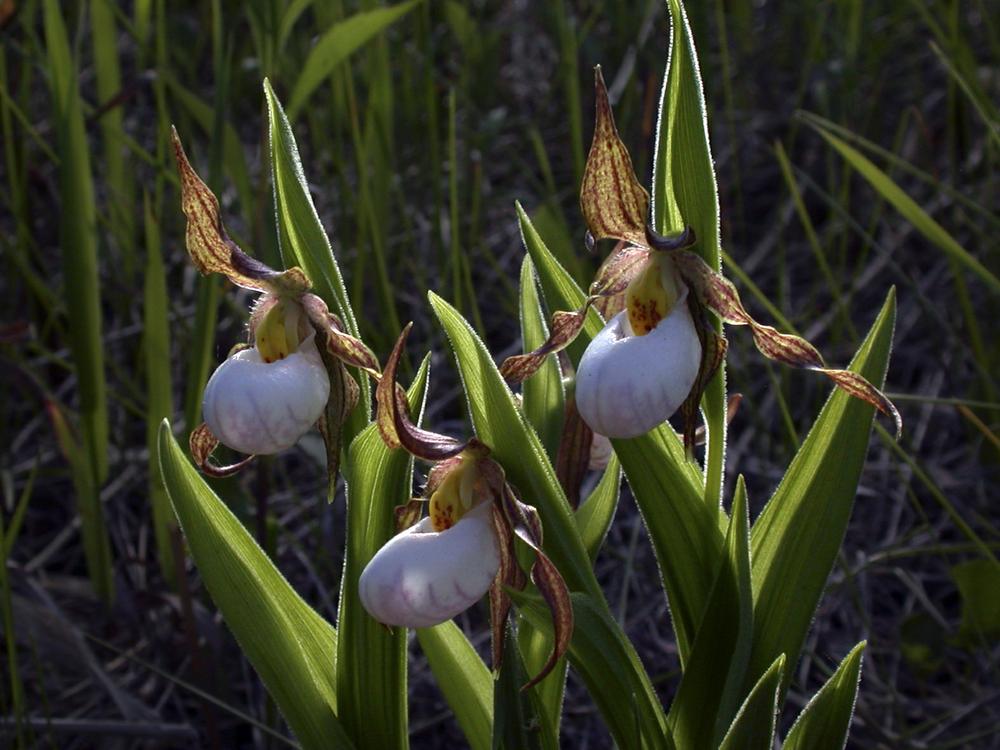
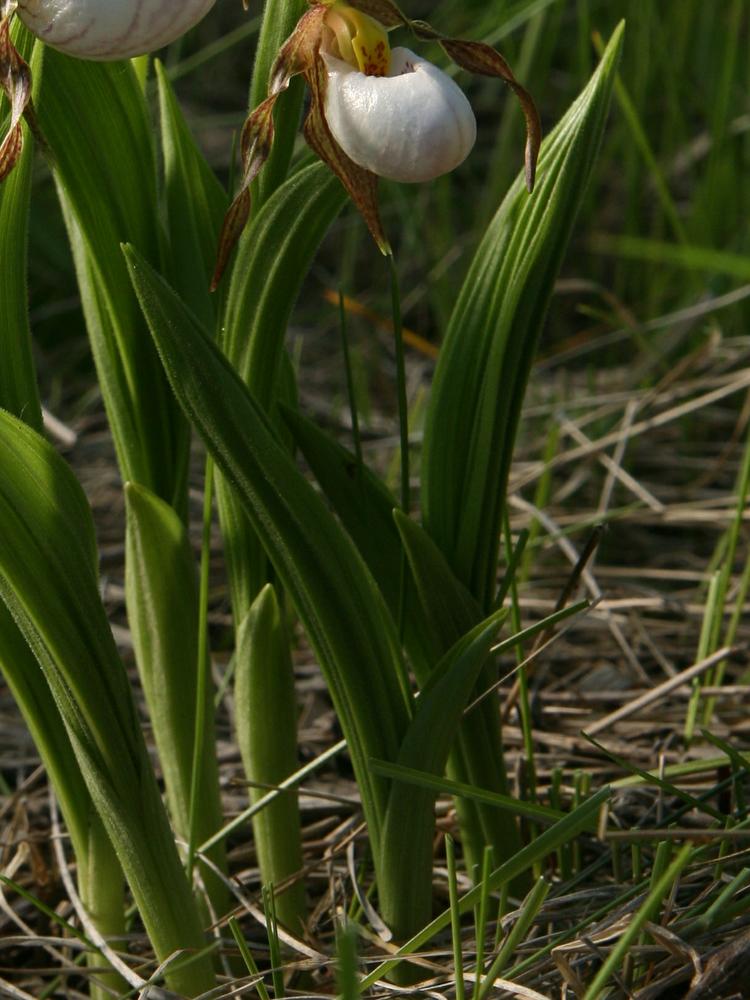
Cypripedium candidum, commonly known as White Lady's Slipper, is found in northeastern and central Canada and the United States, with a disjunct population in two counties of Alabama. Its labellum is a large, inflated, ovate pouch, white with a waxy or shiny surface and often striped with purple on the inside. It produces 3-5 leaves on its stem, and has yellowish green sepals and petals, often spotted with red or purple, which twist away in spirals. It grows in moist, sunny meadows, prairies, and fens; because it cannot tolerate shade, its population diminishes as woody canopies grow.
Cypripedium candidum is globally considered to be apparently secure, but is highly rare throughout much of its southern and central range. It can be distinguished from other Cypripedium species by the acute angle of the labellum orifice. When C. candidum is crossed with C. parviflorum, it produces a recognized hybrid designated as C. × andrewsii.
Pollination
This orchid is pollinated by many kinds of bees including Andrena barbilabris, Andrena ziziae, Augochlorella aurata, Ceratina calcarata, Halictus confusus, Halictus ligatus, Lasioglossum anomalum, Lasioglossum cinctipes, Lasioglossum cressonii, Lasioglossum hitchensi, Lasioglossum pilosum and Lasioglossum rohweri. Hungry bees visit this orchid soon after they emerge in the spring to collect nectar and pollen. The size of the bees and their inexperience in exiting the flowers ensured contact with the anthers of the flowers to collect pollen. In one experiment it took up to 15 minutes for a bee to find its way out of the flower. The twice-stabbed stink bug, Cosmopepla lintneriana, has also been documented as a pollinator.
Ecosystem Type
Fens, grassland, meadows
Characteristics
- Habitat:
- terrestrial
- Leaf arrangement:
- alternate
- Number of leaves on stem:
-
- three
- four
- five
- Form of the labellum:
- the labellum is pouch-like
- Labellum outline:
- the labellum is simple
- Main color of labellum:
- white
- Nectar spur:
- absent
- Inflorescence type:
- the inflorescence has one flower or a pair of flowers
- Labellum characteristics:
- the labellum is saccate
- Labellum length:
- 15–25 mm
- Sepal length:
- 15–35 mm
- Plant height:
- 10–40 cm
-
Flowers
- Floral bract length:
- 35–60 mm
- Flower petal color:
-
- green
- red
- yellow
- Flower symmetry:
- the flower is zygomorphic
- Flowering date:
-
- May
- June
- July
- Flowers per inflorescence:
- 1–2
- Form of the labellum:
- the labellum is pouch-like
- Inflorescence type:
- the inflorescence has one flower or a pair of flowers
- Labellum characteristics:
- the labellum is saccate
- Labellum length:
- 15–25 mm
- Labellum outline:
- the labellum is simple
- Labellum position:
- the flowers are resupinate
- Lower petal strongly red-veined:
- yes
- Main color of labellum:
- white
- Nectar spur:
- absent
- Number of stamens:
- 2
- Orientation of side petals:
- the lateral petals are spreading
- Self-pollinating flowers:
- there are no cleistogamous flowers
- Sepal length:
- 15–35 mm
- Sepals fused only to sepals:
- the sepals are fused to each other (not other flower parts), at least near their bases
-
Fruits or seeds
- Fruit length:
- Up to 30 mm
- Fruit width:
- Up to 15 mm
-
Growth form
- Plant height:
- 10–40 cm
- Roots:
- the rhizomes are non-coralloid
- Underground organs:
-
- slender roots
- this plant has a rhizome
- myco-heterotrophic or not:
- the plant is chlorophyllous
-
Leaves
- Bract relative length:
- the bract is longer than the associated flower
- Leaf arrangement:
- alternate
- Leaf blade length:
- 80–150 mm
- Leaf blade length to width ratio:
- 8.89–2.83
- Leaf blade shape:
-
- elliptic
- lanceolate
- Leaf blade width:
- 9–53 mm
- Leaves during flowering:
- leaves are present during flowering
- Number of leaves on stem:
-
- three
- four
- five
-
Place
- Ecosystem type:
-
- fens
- grasslands
- meadows
- Habitat:
- terrestrial
- Location:
-
- Alabama
- Arkansas
- Illinois
- Indiana
- Iowa
- Kentucky
- Manitoba
- Maryland
- Michigan
- Minnesota
- Missouri
- Nebraska
- New Jersey
- New York
- North Dakota
- Ohio
- Ontario
- Pennsylvania
- Saskatchewan
- South Dakota
- Virginia
- Wisconsin
-
Facts and Uses
- Mycorrhiza
- Monitoring
- Propagation
- Restoration
Native to North America
Yes
North American Conservation Status & Distribution
Conservation Status
| Conservation and Wetland Status | |
|---|---|
| Global Rank | Vulnerable |
| US Status | N/A |
| Canadian Status | Threatened |
| Conservation status for: Alabama | |
|---|---|
| Global Rank | Vulnerable |
| US Status | N/A |
| Alabama Rank | Highly State Rare |
| Alabama Status | Endangered |
| Canadian Status | Threatened |
| Wetland Status | Obligate Wetland |
| Conservation status for: Arkansas | |
|---|---|
| Global Rank | Vulnerable |
| US Status | N/A |
| Arkansas Rank | N/A |
| Arkansas Status | N/A |
| Canadian Status | Threatened |
| Wetland Status | N/A |
| Conservation status for: Iowa | |
|---|---|
| Global Rank | Vulnerable |
| US Status | N/A |
| Iowa Rank | Watch List |
| Iowa Status | Species of Concern |
| Canadian Status | Threatened |
| Wetland Status | Obligate Wetland |
| Conservation status for: Illinois | |
|---|---|
| Global Rank | Vulnerable |
| US Status | N/A |
| Illinois Rank | State Rare |
| Illinois Status | Threatened |
| Canadian Status | Threatened |
| Wetland Status | Obligate Wetland |
| Conservation status for: Indiana | |
|---|---|
| Global Rank | Vulnerable |
| US Status | N/A |
| Indiana Rank | Watch List |
| Indiana Status | Species of Concern |
| Canadian Status | Threatened |
| Wetland Status | Obligate Wetland |
| Conservation status for: Kentucky | |
|---|---|
| Global Rank | Vulnerable |
| US Status | N/A |
| Kentucky Rank | Highly State Rare |
| Kentucky Status | Endangered |
| Canadian Status | Threatened |
| Wetland Status | Obligate Wetland |
| Conservation status for: Manitoba | |
|---|---|
| Global Rank | Vulnerable |
| US Status | N/A |
| Manitoba Rank | State Rare |
| Manitoba Status | Threatened |
| Canadian Status | Threatened |
| Wetland Status | N/A |
| Conservation status for: Maryland | |
|---|---|
| Global Rank | Vulnerable |
| US Status | N/A |
| Maryland Rank | Highly State Rare |
| Maryland Status | Endangered |
| Canadian Status | Threatened |
| Wetland Status | Obligate Wetland |
| Conservation status for: Michigan | |
|---|---|
| Global Rank | Vulnerable |
| US Status | N/A |
| Michigan Rank | State Rare |
| Michigan Status | Threatened |
| Canadian Status | Threatened |
| Wetland Status | Obligate Wetland |
| Conservation status for: Minnesota | |
|---|---|
| Global Rank | Vulnerable |
| US Status | N/A |
| Minnesota Rank | Watch List |
| Minnesota Status | Species of Concern |
| Canadian Status | Threatened |
| Wetland Status | Obligate Wetland |
| Conservation status for: Missouri | |
|---|---|
| Global Rank | Vulnerable |
| US Status | N/A |
| Missouri Rank | Highly State Rare |
| Missouri Status | Endangered |
| Canadian Status | Threatened |
| Wetland Status | Obligate Wetland |
| Conservation status for: North Dakota | |
|---|---|
| Global Rank | Vulnerable |
| US Status | N/A |
| North Dakota Rank | State Rare |
| North Dakota Status | Threatened |
| Canadian Status | Threatened |
| Wetland Status | Obligate Wetland |
| Conservation status for: Nebraska | |
|---|---|
| Global Rank | Vulnerable |
| US Status | N/A |
| Nebraska Rank | Highly State Rare |
| Nebraska Status | Endangered |
| Canadian Status | Threatened |
| Wetland Status | Obligate Wetland |
| Conservation status for: New Jersey | |
|---|---|
| Global Rank | Vulnerable |
| US Status | N/A |
| New Jersey Rank | Highly State Rare |
| New Jersey Status | Endangered |
| Canadian Status | Threatened |
| Wetland Status | Obligate Wetland |
| Conservation status for: New York | |
|---|---|
| Global Rank | Vulnerable |
| US Status | N/A |
| New York Rank | Highly State Rare |
| New York Status | Endangered |
| Canadian Status | Threatened |
| Wetland Status | Obligate Wetland |
| Conservation status for: Ohio | |
|---|---|
| Global Rank | Vulnerable |
| US Status | N/A |
| Ohio Rank | State Rare |
| Ohio Status | Threatened |
| Canadian Status | Threatened |
| Wetland Status | Obligate Wetland |
| Conservation status for: Ontario | |
|---|---|
| Global Rank | Vulnerable |
| US Status | N/A |
| Ontario Rank | Highly State Rare |
| Ontario Status | Endangered |
| Canadian Status | Threatened |
| Wetland Status | N/A |
| Conservation status for: Pennsylvania | |
|---|---|
| Global Rank | Vulnerable |
| US Status | N/A |
| Pennsylvania Rank | Presumed Extirpated |
| Pennsylvania Status | Endangered |
| Canadian Status | Threatened |
| Wetland Status | Obligate Wetland |
| Conservation status for: South Dakota | |
|---|---|
| Global Rank | Vulnerable |
| US Status | N/A |
| South Dakota Rank | Highly State Rare |
| South Dakota Status | Endangered |
| Canadian Status | Threatened |
| Wetland Status | Obligate Wetland |
| Conservation status for: Saskatchewan | |
|---|---|
| Global Rank | Vulnerable |
| US Status | N/A |
| Saskatchewan Rank | Possible Extirpated |
| Saskatchewan Status | Endangered |
| Canadian Status | Threatened |
| Wetland Status | N/A |
| Conservation status for: Virginia | |
|---|---|
| Global Rank | Vulnerable |
| US Status | N/A |
| Virginia Rank | Highly State Rare |
| Virginia Status | Endangered |
| Canadian Status | Threatened |
| Wetland Status | Obligate Wetland |
| Conservation status for: Wisconsin | |
|---|---|
| Global Rank | Vulnerable |
| US Status | N/A |
| Wisconsin Rank | Watch List |
| Wisconsin Status | Threatened |
| Canadian Status | Threatened |
| Wetland Status | Obligate Wetland |